
September 15, 2026
How Teachers Can Use AI to Create a Syllabus More Aligned With Their Student-Centered Values
The Syllabus Whiplash
For a long time, I hated handing out a syllabus.
I’d work so hard to welcome my new students, learn all their names, and set the tone for a really fun and positive year ahead, and then BAM. Here’s a giant document that looks like a legal contract, full of rules and consequences you should bring home to be signed by a parent.
This never felt right.
What Is My Syllabus Really Communicating?
- Is this really the best way to communicate this information with my students and their families?
- What else am I communicating here about what I value or what the class needs?
- How do I make this more aligned with who I am and the kind of teacher I want to be?
- How do I use the syllabus to build culture and connection?
What actually IS the purpose of a syllabus?
I didn’t have a solid answer to that. So, I decided to just NOT hand out a syllabus.
I still went over the nuts and bolts in pieces over a few days. I’d talk about grading and my expectations; we would co-create norms for the class and talk about how we want the class to feel or what students hope to learn… But this wasn’t the solution I was looking for either.
A few years ago I decided the purpose was to communicate logistics like what students need to have and how I grade the course. So, I brought back the written syllabus in the form of a slide deck. (Hello, distance teaching with a slide deck for everything anyways.) This eased the transition from “Hi, welcome to my super fun and amazing class” to “here’s what you need to NOT do.”
But in my attempt to avoid the whiplash, I should have done more than make my syllabus pretty, invisible, or vague… I needed to examine the actual policies and practices that were feeling misaligned with what I valued.
I realized my problem wasn’t that I didn’t really know what the purpose of a syllabus was. Instead, I wondered what my syllabus was communicating about what I believe.
And then I started wondering… What if every teacher asked that question? If instead of asking if we covered all of our bases and checked all the boxes for what we do and don’t want students to do, what if we asked
What is my syllabus teaching students about what I believe?
Let me share some examples… A teacher might say,
- “I want students to be honest when they’re struggling,” but the syllabus might say, “Late work is not accepted for any reason.”
- “I care about you as whole people,” but the syllabus might focus mostly on what happens when they miss deadlines, forget materials, or make mistakes.
- “I want students to think critically and use tools responsibly,” but the syllabus might frame AI only as a threat: “Any use of AI will be treated as cheating.”
That tension is important to name. Once I realized that was the part that had bothered me for so long, I started to see my syllabus differently. It was no longer just a document for rules, policies, and expectations. It was an opportunity to show students what I value and what they can expect from our class. Before they know me well, the syllabus can help communicate that I see them as capable people, that I care about their learning, and that this class is something we will build together.
I’ve shifted from thinking about the syllabus as a tool for compliance to a tool for communication.
Expectations Can Still Sound Human
That does not mean removing expectations or making policies vague. Students need clarity. Teachers need boundaries. But I want those expectations to sound like they belong in the type of class I am trying to build. I need my words to match the kind of educator I am.
Try Looking at Your Syllabus Through a Different Lens
We are in luck now, friends! AI can help us look at the work we already have with fresh eyes. AI can be a helpful mirror. It can help you notice whether the words on the page match the kind of classroom you’re trying to build.
I created a custom GPT, The Syllabus Vibe Check Chatbot, to help teachers review an existing syllabus and ask:
What is this document communicating about my class, my expectations, and what I believe about students?
Before you paste in or upload your syllabus, take a minute to remove any personal information you do not want to share, like your phone number, personal email, or other private details. You can leave in the policies, routines, and language you want feedback on.
Once your syllabus is ready, the bot looks for places where the language may feel overly rigid, confusing, vague, or compliance-driven. Then it offers revision ideas to help your syllabus sound more student-centered while still keeping the expectations and boundaries you need.
It might help you reword a late work policy so it still holds students accountable while making the path forward clear.
It might suggest ways to introduce AI use in your class without making AI sound only like a threat.
It might even suggest ways to introduce the syllabus as an invitation into your classroom instead of as a contract.
The goal is a more intentional syllabus. Use the suggestions that sound like you. Revise the ones that are close. Toss the ones that do not fit! You are in charge here. Only you know your course and the full intent behind your policies.
AI can offer the mirror. You decide what belongs.
Try the Syllabus Vibe Check
Link to The Syllabus Vibe Check Chatbot
I love that AI can help me see my work differently. You might discover that you don’t need a brand-new syllabus. You just need to read the one you already have with fresh eyes and just make small tweaks.
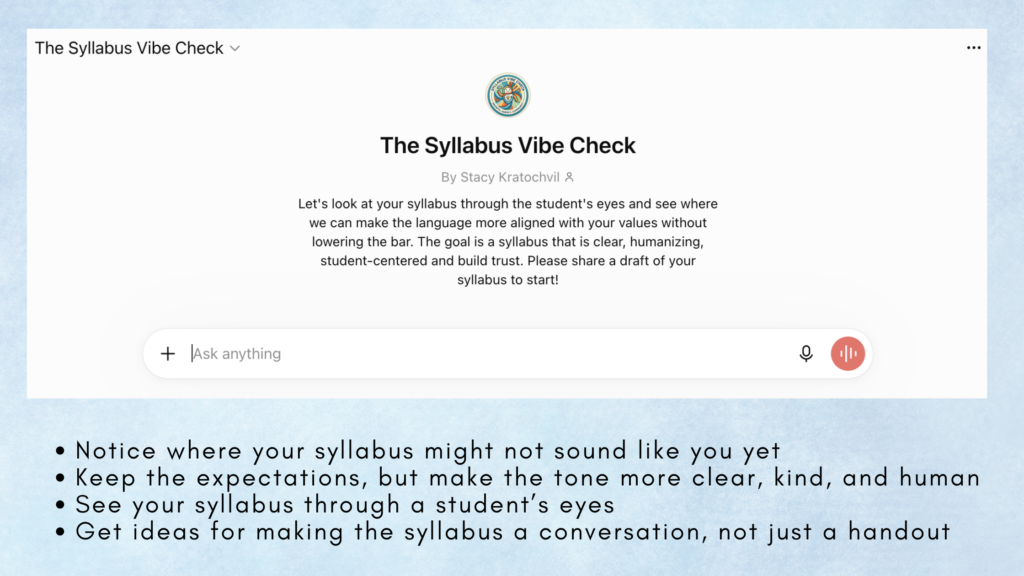
Try the Syllabus Vibe Check Chatbot, and follow KCI for more practical, human-centered ways to bring AI into your teaching. We’ll keep sharing tools, questions, and ideas that help you use technology with care, clarity, and purpose.
Note on AI use: AI helped to organize the structure of this blog. The stories and reflections were written by me, and the graphics were made without AI.
Share Post
Post Author
-

Stacy Kratochvil